
South African equities declined modestly in October, recording a second consecutive negative month as weakness in precious metal miners offset stronger performance from domestically focused sectors. The FTSE/JSE All Share Index declined -0.8% MoM, while the Resources 10 Index fell -9.2% MoM as gold and PGM miners remained under pressure. Gold declined -6.8% MoM, while platinum and palladium fell -16.4% and -19.0% MoM respectively. In contrast, financials gained +2.7% MoM and industrials advanced +3.7% MoM, supported by stronger performance from telecommunications, insurers and selected retailers. Local bonds outperformed equities, with the FTSE/JSE All Bond Index gaining +2.1% MoM, while SA-listed property rose +0.6% MoM. In US dollar terms, MSCI South Africa declined -4.1% MoM, outperforming MSCI Emerging Markets (-8.1% MoM) but underperforming MSCI World (-0.8% MoM).
South Africa’s macroeconomic backdrop remained relatively resilient in October, with inflation continuing to surprise modestly to the downside while the Medium-Term Budget Policy Statement (MTBPS) reaffirmed government’s commitment to fiscal consolidation. Headline inflation increased marginally to 4.5% YoY in September from 4.4% in August. The MTBPS left the projected budget deficit broadly unchanged at 3.7% of GDP for FY2027 and 3.3% for FY2028, with slightly stronger tax revenue allowing government to increase capital expenditure, reduce the fuel levy further and bolster contingency reserves. National Treasury also announced a larger-than-expected reduction in weekly fixed-rate bond issuance, providing support to the local bond market. The 10-year government bond yield declined by approximately 20 basis points to end the month at c. 8.8%, while the rand weakened -1.7% MoM amid broader US dollar strength.
Global equity markets declined for a second consecutive month in October as a sharp sell-off in AI-related technology shares and emerging markets offset gains across more defensive sectors. The MSCI World Index fell -0.8% MoM, while MSCI Emerging Markets declined a much sharper -8.1% MoM. Concerns around the scale of AI-related capital expenditure and whether these investments would generate sufficient returns weighed on technology and semiconductor shares, prompting a rotation towards energy, healthcare, consumer staples and utilities. Commodity markets remained highly divergent. Brent crude surged +13.6% MoM to approximately US$118/bbl as geopolitical tensions in the Middle East continued to threaten energy supply, while precious metals weakened further, with gold declining -6.8% MoM and platinum and palladium recording double-digit losses.
US equity markets delivered mixed returns in October as a sharp reversal in mega-cap technology and semiconductor shares masked considerably stronger performance across the broader market. The S&P 500 declined -0.9% MoM and the Nasdaq 100 fell -6.7% MoM, while the Dow Jones Industrial Average gained +1.7% MoM as investors rotated towards more defensive and value-oriented sectors. US inflation remained elevated, with headline CPI accelerating to 3.7% YoY in September from 3.4% in August and core PCE inching up to 3.1% YoY. The Federal Reserve left rates unchanged at its October meeting following September’s 25 basis point increase, while the US 10-year Treasury yield declined from the previous month’s highs to end October at approximately 4.9%.
European equity markets proved relatively resilient in October as their lower exposure to technology and greater weighting towards defensive sectors provided some insulation from the global AI-related sell-off. The MSCI Europe ex-UK Index gained +1.5% MoM, while Germany’s DAX advanced +2.5% and France’s CAC 40 edged +0.1% higher. Political and fiscal uncertainty in France remained a headwind, contributing to higher French government borrowing costs and continued pressure on financial shares. Eurozone inflation increased to 4.0% YoY in October, while the European Central Bank left interest rates unchanged at its October meeting. UK equities were among the stronger developed markets, with the FTSE 100 gaining +1.2% MoM as its relatively high exposure to energy and defensive sectors benefited from the rotation away from technology. UK inflation accelerated further to 3.5% YoY in September from 3.1% previously, reflecting continued pressure from higher energy and transport costs.
Emerging market equities came under significant pressure in October, with the MSCI Emerging Markets Index declining -8.1% MoM as the sell-off in AI-related technology shares weighed particularly heavily on Asian markets. South Korea’s KOSPI and Taiwan’s Weighted Index fell -16.2% and -5.7% respectively as investors reassessed the scale and potential returns of AI-related capital expenditure, despite continued strength in underlying semiconductor demand. Chinese equities weakened materially, with the Shanghai Composite declining -6.3% MoM and Hong Kong’s Hang Seng Index falling -5.4% MoM amid a sharp unwinding of positions in domestic AI and semiconductor shares and continued concerns around the underlying economy. China’s economic data also softened, with the official manufacturing PMI declining to 49.3 in October from 50.1 in September, while the non-manufacturing PMI fell to 49.7 from 50.2, placing both measures back below the 50-point threshold separating expansion from contraction.
The hedge fund was negative in October, as detractors from the long book outweighed gains from the short book. On the long side, contributions from British American Tobacco, Reinet Investments, Old Mutual and Bid Corporation were more than offset by detractors across technology (Tencent), PGM mining (Northam Platinum and Impala Platinum), banking (Piraeus Bank) and gold mining (Barrick Mining) positions. British American Tobacco, Reinet and Old Mutual benefited from a rotation towards more defensive businesses, while Bid Corporation was supported by sector rotation. Tencent weakened alongside a sell-off in Chinese equities, while Northam Platinum and Impala Platinum came under pressure as platinum and palladium prices fell sharply. Piraeus Bank weakened amid profit-taking across Greek banks following strong earlier gains. Barrick Mining also detracted as “higher for longer” interest rate expectations drove a further correction in the gold price.
South African equities came under significant pressure in September, reversing much of August’s strong performance as precious metal prices corrected sharply and global bond yields moved higher. The FTSE/JSE All Share Index declined -6.7% MoM, while the Resources 10 Index fell -11.0% MoM as gold and PGM miners bore the brunt of the sell-off. Gold declined -6.3% MoM, while platinum and palladium fell -4.5% and -11.5% MoM respectively, as rising global interest rates and a stronger US dollar increased the opportunity cost of holding non-yielding assets. Financials declined -4.4% MoM and industrials fell -5.9% MoM, although selected retailers proved more resilient. Local bonds outperformed equities as the FTSE/JSE All Bond Index closed the month flat MoM, while SA-listed property edged +0.3% higher. In US dollar terms, MSCI South Africa declined -10.0% MoM, significantly underperforming both MSCI World (-1.3% MoM) and MSCI Emerging Markets (-0.8% MoM).
South Africa’s inflation backdrop remained relatively contained in September, although rising oil prices and tighter global monetary conditions increased risks to the outlook. Headline inflation edged up to 4.4% YoY in August from 4.3% in July. Against this backdrop, the South African Reserve Bank unanimously raised the repo rate by 25 basis points to 7.25%, reversing July’s decision to leave rates unchanged. The SARB highlighted the persistence of the oil-driven supply shock, sticky services inflation and a more hawkish global interest-rate environment as reasons for adopting a more restrictive stance. Local bond yields moved higher alongside global yields, with the South African 10-year government bond yield rising above 9.0%. The rand weakened -1.9% MoM against the greenback, reflecting a stronger US dollar, higher global yields and a more cautious risk environment.
Global equity markets weakened in September as sharply higher bond yields, renewed inflation concerns and elevated oil prices outweighed resilient economic activity and corporate earnings. The MSCI World Index declined -1.3% MoM, while MSCI Emerging Markets fell a more modest -0.8% MoM. Government bond markets were particularly volatile as central banks returned to monetary tightening and investors reassessed the outlook for inflation and government borrowing. The US 10-year Treasury yield moved above 5% for the first time since before the Global Financial Crisis, while yields across Europe and Japan also reached multi-year highs. Commodity performance diverged sharply. Brent crude gained +14.4% MoM to close above US$100/bbl as continued tensions in the Middle East renewed concerns around global energy supply. In contrast, higher real yields and a stronger US dollar weighed on precious metals, with gold declining -6.3% MoM, platinum falling -4.5% and palladium losing -11.5%. Despite these headwinds, global economic activity remained resilient, with September purchasing managers’ indices indicating continued expansion across several major economies.
US equity markets delivered mixed returns in September as continued strength in AI-related shares masked considerably weaker performance across the broader market. The S&P 500 declined -0.5% MoM and the Dow Jones Industrial Average fell -4.3% MoM, while the technology-heavy Nasdaq 100 gained +3.2% MoM. Market leadership remained exceptionally narrow, with semiconductor and mega-cap technology shares continuing to benefit from strong AI-related demand even as higher interest rates weighed on most other sectors. The Federal Reserve raised the target range for its policy rate by 25 basis points to 3.75–4.00% and maintained a hawkish stance, prompting investors to increase expectations for further tightening. The US 10-year Treasury yield rose to 5.3%, adding further pressure to equity valuations. Inflation remained sticky, with headline CPI and core PCE unchanged at 3.4% YoY and 3.0% YoY respectively in August, although core inflation eased to 2.4%. Despite tighter financial conditions, economic activity remained resilient, with second-quarter GDP growth revised higher.
European equity markets weakened in September as higher borrowing costs, renewed inflation concerns and elevated energy prices weighed on investor sentiment. The MSCI Europe ex-UK Index declined -2.6% MoM as Germany’s DAX fell -4.0% and France’s CAC declined -4.4%. The European Central Bank raised interest rates during the month and cautioned that inflation could remain elevated, contributing to higher sovereign bond yields and pressure on equity valuations. Eurozone inflation accelerated to 3.8% YoY in September from 3.2% in August, driven primarily by higher energy prices. UK equities also lost ground, with the FTSE 100 declining -2.0% MoM as rising bond yields offset some of the index’s relative support from its exposure to energy and commodity-related companies. The Bank of England left its policy rate unchanged at 3.75%, while UK inflation increased to 3.1% YoY in August, its highest level in five months, reflecting renewed pressure from transport and fuel costs.
Emerging market equities proved relatively resilient in September despite a challenging backdrop of higher developed-market bond yields, rising oil prices and a stronger US dollar. The MSCI Emerging Markets Index declined -0.8% MoM, outperforming developed markets as renewed strength in the global AI trade supported technology-heavy Asian markets, particularly Taiwan and South Korea. Both benefited from continued demand for semiconductor hardware and expectations of persistent supply constraints. Chinese equities, however, remained under pressure. The Shanghai Composite declined -3.6% MoM, while Hong Kong’s Hang Seng Index fell -3.7% MoM as weak macroeconomic data and geopolitical concerns continued to weigh on sentiment despite ongoing policy support. Encouragingly, China’s official manufacturing PMI improved to 50.1 in September from 49.8 in August, returning to expansionary territory, while the non-manufacturing PMI increased to 50.2 from 49.0. Nevertheless, underlying domestic demand remained fragile and Chinese equities continued to lag their regional peers.
The hedge fund slipped into negative territory in September, as detractors from both the long and short books weighed on performance. On the long side, contribution from Grindrod was more than offset by detractors across gold mining (Gold Fields and Barrick Mining), technology (Tencent and Oracle) and PGM mining (Northam Platinum and Impala Platinum) positions. Grindrod contributed positively as record Port of Maputo volumes, strong interim earnings and continued progress on terminal expansion and South Africa’s rail reforms reinforced confidence in its growth outlook. Gold Fields and Barrick Mining came under pressure as rising global bond yields and a stronger US dollar drove a sharp correction in the gold price, while Gold Fields was additionally weighed down by concerns around its proposed Northern Star acquisition. Tencent weakened amid deteriorating sentiment towards Chinese equities while Northam Platinum and Impala Platinum also detracted as weaker platinum and palladium prices triggered profit-taking across the PGM sector.
South African equities delivered a strong performance in August, with the FTSE/JSE All Share Index gaining +4.3% MoM and recording a second consecutive positive month, driven overwhelmingly by a sharp recovery in precious metal prices. Resources were the standout performer, with the FTSE/JSE Resources 10 Index surging +25.4% MoM as gold and PGM miners rallied alongside stronger underlying commodity prices. Gold advanced +9.7% MoM, while platinum and palladium rose +9.0% and +6.3% MoM respectively. In contrast, performance outside the resources sector was considerably weaker, with financials declining -1.7% MoM and industrials falling -5.8% MoM. The FTSE/JSE All Bond Index gained a modest +0.7% MoM, while SA-listed property declined -3.9% MoM. In US dollar terms, MSCI South Africa gained +11.2% MoM, significantly outperforming both MSCI World (+2.5% MoM) and MSCI Emerging Markets (+3.2% MoM), supported by the strong local equity market performance and a +2.6% MoM appreciation in the rand against the US dollar.
South Africa’s macroeconomic backdrop improved modestly in August as headline inflation retreated from its recent peak, although underlying inflationary pressures remained elevated. Headline inflation moderated to 4.3% YoY in July from 5.0% in June, helped by weaker-than-expected food and public transport inflation. Food inflation fell to just 0.6% YoY, supported by good harvests and favourable weather conditions, while the impact of the earlier foot-and-mouth disease outbreak on meat prices continued to fade. The domestic labour market also remained under pressure, with the official unemployment rate rising to 33.6% in the second quarter from 32.7% previously. Despite these challenges, local financial markets benefited from the weaker US dollar and renewed strength in South Africa’s key commodity exports, with the rand appreciating +2.6% MoM.
Global equity markets recovered strongly in August following July’s technology-led correction, supported by resilient economic activity, robust corporate earnings and a recovery in technology shares. The MSCI World Index gained +2.5% MoM, while MSCI Emerging Markets advanced +3.2% MoM. Technology shares regained momentum as semiconductor stocks recovered from their July sell-off and strong earnings helped alleviate some concerns around the sustainability of AI-related investment. However, volatility increased towards month-end as investors confronted renewed geopolitical tensions in the Middle East, persistent concerns around government debt and a more hawkish Federal Reserve. Commodity markets were particularly strong, with gold gaining +9.7% MoM to record its strongest monthly performance since January, while platinum (+9.0% MoM) and palladium (+6.3% MoM) also advanced. Brent crude remained volatile as hopes of an agreement to reopen the Strait of Hormuz faded, ending the month above US$90/bbl. The combination of geopolitical uncertainty, concerns around government indebtedness and a weaker US dollar also renewed investor interest in real assets and the broader “debasement trade”.
US equity markets rebounded in August as strong second-quarter corporate earnings and renewed enthusiasm for technology stocks outweighed elevated bond yields and geopolitical uncertainty. The S&P 500 gained +2.6% MoM, while the Nasdaq 100 rose +4.2% MoM as technology stocks recovered from July’s sharp sell-off. The Dow Jones Industrial Average gained +1.4% MoM. AI remained a key market driver, with strong results and guidance from Nvidia helping restore confidence in semiconductor demand, while Microsoft continued its recovery following strong cloud-related earnings. US economic activity also remained resilient, with the flash Composite PMI reaching its highest level in more than four years. Inflation data were somewhat more encouraging, with headline inflation moderating to 3.4% YoY in July from 3.5% in June and core inflation declining to 2.5% YoY. However, the Federal Reserve’s preferred core PCE measure remained elevated at 3.3% YoY. Fed Chair Kevin Warsh reinforced the central bank’s commitment to its 2% inflation target at Jackson Hole, prompting markets to increase expectations for further monetary tightening. The US 10-year Treasury yield ended the month broadly unchanged at approximately 4.74%, while the US Dollar Index declined -0.5% MoM.
European equity markets delivered mixed returns in August as resilient economic growth and improving corporate earnings were offset by renewed energy-price concerns and rising inflation. The MSCI Europe ex-UK Index rose +0.6% MoM, while Germany’s DAX advanced +2.5% MoM and reached a fresh record high. France’s CAC declined -2.1% MoM, weighed down by weakness in luxury shares as softer international demand raised concerns around the sector’s earnings outlook. Eurozone GDP expanded by a stronger-than-expected +0.4% QoQ in the second quarter, while inflation increased to 3.3% YoY in August from 2.9% in July, reflecting continued pressure from energy prices. UK equities underperformed, with the FTSE 100 declining -0.4% MoM after approaching record highs earlier in the month. UK inflation accelerated to 2.9% YoY from 2.6%, largely reflecting a sharp increase in regulated household energy prices, reinforcing expectations that the Bank of England will remain cautious about further monetary easing.
Emerging market equities recovered in August, with the MSCI Emerging Markets Index gaining +3.2% MoM as technology-heavy Asian markets rebounded from July’s semiconductor-driven correction. Taiwan was among the strongest performers as AI-related semiconductor shares recovered, while South Korean equities also stabilised following their sharp decline in the previous month. Chinese equity markets were more mixed. The Shanghai Composite gained +4.0% MoM as mainland equities benefited from continued policy support and renewed interest in domestic technology and AI-related companies, while Hong Kong’s Hang Seng Index declined -1.2% MoM amid continued weakness in the property sector and uncertainty around prospective policy changes. China’s economic data remained subdued, with the official manufacturing PMI improving to 49.8 in August from 49.2 in July but remaining below the 50-point threshold separating expansion from contraction. The non-manufacturing PMI remained at 49.0, highlighting continued weakness in domestic demand despite ongoing policy support.
The hedge fund remained in positive territory in August, as gains from the long book more than offset losses from the short book. Performance on the long side was driven primarily by positions across the gold, PGM and diversified mining sectors, including Barrick Mining, Harmony Gold, Wheaton Precious Metals, Northam Platinum and Anglo American. Gold miners Barrick Mining, Harmony Gold and Wheaton Precious Metals benefited from a strong rise in the gold price amid renewed geopolitical and inflation concerns, with solid operational results, strong cash generation and shareholder returns providing additional support. PGM producers also rallied as higher platinum, palladium and rhodium prices improved sentiment towards the sector, with Northam Platinum further supported by record earnings, a record dividend and an unsolicited takeover approach. Anglo American also added to performance as firmer commodity prices, particularly copper, combined with stronger underlying earnings and continued progress on its portfolio simplification strategy, reinforced confidence in the group’s long-term outlook. Within the short book, the fund’s index protection and selected short positions in gold ETFs (which are paired against some of our gold longs) detracted from performance during the month.
South African equities returned to positive territory in July, ending a two-month losing streak as gains in resources, rand-hedge counters and investment holding companies offset weakness in domestically focused consumer shares. The FTSE/JSE All Share Index advanced +1.1% MoM, outperforming the FTSE/JSE All Bond Index, which declined -1.4% MoM. South African listed property was once again the best-performing local asset class, gaining +1.9% MoM. Resources rose +2.2% MoM, supported by a rebound in platinum miners and strength in diversified mining and energy shares, while financials gained +1.2% MoM and industrials delivered a more modest +0.3% MoM return. In US dollar terms, MSCI South Africa fell -0.3% MoM, underperforming MSCI World (+0.5% MoM) but outperforming MSCI Emerging Markets (-3.3% MoM), as the rand weakened -0.9% MoM against the US dollar.
South Africa’s macroeconomic backdrop became more challenging in July as inflation continued to rise and the South African Reserve Bank surprised markets by leaving interest rates unchanged. Headline inflation accelerated to 5.0% YoY in June from 4.5% previously, with fuel and insurance costs among the main contributors. Despite these pressures, the SARB voted 4 – 2 to keep the repo rate unchanged at 7.0%, defying expectations for a 25-basis-point increase. The unexpectedly dovish decision placed pressure on local assets, with the rand weakening by approximately 0.9% MoM and pushing the 10-year government bond yield above 8.8%. Fiscal developments were more encouraging, with government revenue collections through June tracking comfortably ahead of National Treasury’s projections, providing a more supportive backdrop for the fiscal outlook. Nevertheless, persistent core inflation, elevated oil prices and uncertainty ahead of municipal elections suggest that domestic interest rates may need to remain higher for longer.
Global equity markets delivered a modest positive return in July, although the subdued headline performance concealed considerable volatility beneath the surface. The MSCI World Index gained +0.5% MoM, as strength in energy, financials and selected value-oriented sectors offset a sharp correction in semiconductor and AI-related shares. The month was shaped by two competing forces. Renewed escalation in the US-Iran conflict disrupted shipping through the Strait of Hormuz and drove Brent crude oil sharply higher, while investors simultaneously reassessed the sustainability of the AI capital expenditure cycle and the elevated valuations attached to many technology beneficiaries. Semiconductor shares, which had led global markets during the first half of the year, sold off heavily amid concerns around future returns, export restrictions and China’s growing technological capabilities. Forced deleveraging by highly leveraged investors amplified the decline before sentiment stabilised towards month-end. Commodity markets were mixed: Brent crude rose approximately +23.6% MoM, while gold posted only modest gains of +1% MoM and platinum group metals recovered from their June lows to rise +6.2% MoM.
US equity markets were mixed in July despite another strong corporate earnings season. The S&P 500 was broadly unchanged, declining -0.1% MoM, while the Nasdaq 100 fell -6.6% MoM as semiconductor weakness and renewed concerns around technology valuations weighed on the index. The Dow Jones Industrial Average gained +0.3% MoM, supported by energy, financial and other value-oriented sectors. Second-quarter earnings remained robust, with approximately 85% of reporting S&P 500 companies exceeding analyst expectations and aggregate earnings growing strongly. However, investors increasingly demanded evidence that elevated AI-related capital expenditure would translate into sustainable returns, rather than rewarding spending alone. Large technology companies with accelerating cloud revenues were treated more favourably, while companies raising capital expenditure guidance without a commensurate improvement in earnings expectations faced greater scrutiny. On the policy front, the Federal Reserve kept rates unchanged in a 9–3 vote as Chair Kevin Warsh reiterated the committee’s commitment to restoring price stability. Headline inflation slowed to 3.5% YoY in June, while core inflation also dropped to 2.6% YoY in June 2026. US Treasury yields rose sharply, with the 10-year yield ending the month near 4.74%, while the US Dollar Index declined -1.3% MoM.
European equity markets delivered modest gains in July as resilient earnings and easing inflation helped offset renewed energy-price volatility and hawkish central-bank guidance. The MSCI Europe ex-UK Index rose +0.9% MoM, while France’s CAC advanced +1.3% MoM and Germany’s DAX gained +2.5% MoM. Eurozone inflation ticked up slightly to 2.9% YoY in July from 2.8% YoY in June as elevated oil prices remained a risk to the outlook. The UK was one of the strongest developed markets during the month, with the FTSE 100 rising +3.5% MoM and reaching a new record high. Its relatively low exposure to technology and greater weighting towards energy and financial shares proved beneficial during the global semiconductor sell-off. UK inflation eased to 2.6% YoY, while the Bank of England kept its policy rate unchanged at 3.75%. Political uncertainty also diminished as Andy Burnham assumed office as Prime Minister following Keir Starmer’s resignation in June.
Emerging market equities came under pressure in July as the sharp reversal in semiconductor shares weighed heavily on technology-oriented Asian markets. The MSCI Emerging Markets Index declined -3.3% MoM, with South Korea and Taiwan among the largest detractors as leading chipmakers experienced steep losses. Emerging markets remain particularly exposed to the semiconductor manufacturing supply chain, leaving the asset class vulnerable to shifts in sentiment towards AI infrastructure spending. China, however, moved in the opposite direction. Hong Kong listed Chinese equities rallied strongly as policymakers announced a range of stimulus measures, mobilised state-linked institutions to support markets and introduced further monetary easing. The Hang Seng rose +13.2% MoM, supported by a rebound in Chinese technology shares, while the Shanghai Composite declined -6.4% MoM as domestic growth concerns persisted. China’s official manufacturing PMI fell to 49.2 and non-manufacturing PMI declined to 49.0, signalling contraction in both sectors. The divergence highlighted the extent to which policy support and market flows temporarily outweighed a still-fragile underlying economic backdrop.
The hedge fund returned to positive territory in July, as gains from both the long and short books contributed positively to returns. Performance on the long side was driven primarily by positions in European banks (Piraeus Financial Holdings, ING Group and Alpha Bank), which benefited from continued strength in the European banking sector, supported by resilient earnings, robust capital generation and improving shareholder returns. Technology stocks (Tencent and Microsoft) also contributed strongly as improving sentiment towards global technology companies and Microsoft’s earnings-driven rally over the final two trading days of the month lifted the sector. These gains were partially offset by weaker performance from AVI and Raubex, reflecting ongoing pressure on domestic consumer-facing businesses and profit-taking in construction shares. Within the short book, gains were generated from the fund’s Nasdaq index protection, while modest losses stemmed from selected positions in the tobacco and South African listed property sectors.
South African markets delivered another mixed month in June, with bonds and listed property outperforming equities as the sharp correction in precious metal prices continued to weigh on the local bourse. The FTSE/JSE All Bond Index gained +1.5% MoM, while SA-listed property advanced +3.3% MoM. In contrast, the FTSE/JSE All Share Index declined -3.8% MoM, as weakness in resources more than offset resilient gains across financials and industrials. The FTSE/JSE Africa Resource 10 Index fell -16.4% MoM, with gold and platinum miners bearing the brunt of the sell-off as geopolitical risk premiums unwound and commodity prices retreated sharply. Financials (+2.6% MoM) and industrials (+1.9% MoM) proved more resilient, supported by continued strength in banks, retailers and other domestically focused sectors. In US dollar terms, MSCI South Africa declined -6.8% MoM, underperforming both MSCI World (-0.8% MoM) and MSCI Emerging Markets (-1.7% MoM), as lower commodity prices and a firmer US dollar weighed on investor sentiment.
South Africa’s macroeconomic backdrop remained relatively resilient despite inflationary pressures continuing to build. Headline inflation accelerated to 4.5% YoY in May from 4.0% previously, reflecting the delayed pass-through of higher global energy prices, while core inflation rose to 3.8% YoY. Encouragingly, first-quarter GDP growth surprised to the upside, expanding by 0.5% QoQ, supported by stronger activity across the trade, construction and financial sectors. Despite the firmer inflation backdrop, local bond markets remained well supported, with the 10-year government bond yield declining by around 10 basis points to 8.3%, reflecting confidence in South Africa’s fiscal framework, attractive real yields and improving economic momentum. The rand weakened modestly by 1.0% MoM against the US dollar, largely reflecting softer commodity prices and renewed US dollar strength.
Global equity markets paused in June following an exceptionally strong second quarter, with both developed and emerging market equities posting modest declines as investors balanced resilient corporate earnings against persistent inflation concerns, evolving AI valuations and ongoing geopolitical uncertainty. While headline index returns were subdued, market leadership continued to evolve beneath the surface as capital increasingly flowed towards companies supplying the infrastructure underpinning the AI investment cycle, rather than those expected to benefit from AI adoption further downstream. Meanwhile, commodity markets moved sharply lower as tensions in the Middle East eased following the US-Iran memorandum aimed at reopening the Strait of Hormuz. Brent crude oil fell -20.8% MoM, while gold (-11.7% MoM) and platinum (-19.2% MoM) extended their recent declines as safe-haven demand faded and investors became more confident that the Federal Reserve would remain committed to containing inflation.
US equity markets delivered mixed returns in June as investors became increasingly selective within the technology sector. The S&P 500 declined -1.1% MoM, while the Nasdaq 100 was broadly unchanged (-0.2% MoM), masking significant divergence beneath the surface. In contrast, the Dow Jones Industrial Average gained +2.5% MoM, reflecting continued rotation into more cyclical, industrial and value-oriented sectors. Within technology, investors rotated away from richly valued software companies and several mega-cap AI beneficiaries, while semiconductor and memory-chip manufacturers continued to outperform as demand for AI infrastructure remained robust. As the AI investment cycle matured, markets became increasingly discerning, favouring companies supplying the infrastructure underpinning the AI build-out over those expected to monetise the technology further downstream. On the policy front, headline inflation accelerated to 4.2% YoY, while the Federal Reserve kept interest rates unchanged at its June meeting. At his first meeting as Chair, Kevin Warsh maintained a hawkish tone, signalling that policymakers remain prepared to tighten monetary policy further should inflation prove more persistent than expected. Higher Treasury yields and a firmer US dollar also weighed on investor sentiment during the month.
European equity markets proved relatively resilient in June, outperforming the US despite heightened geopolitical uncertainty and continued inflation pressures. The MSCI Europe ex-UK Index rose +3.4% MoM, supported by financials and industrials, while France’s CAC advanced +2.7% MoM. In contrast, Germany’s DAX was marginally weaker, declining -0.4% MoM. Encouragingly, eurozone headline inflation eased to 2.8% YoY, reinforcing expectations that underlying price pressures continue to moderate despite lingering uncertainty around energy markets. In the UK, the FTSE 100 gained +0.8% MoM despite renewed political uncertainty following Prime Minister Keir Starmer’s resignation. UK inflation remained unchanged at 2.8% YoY, supporting expectations that the Bank of England will maintain a cautious approach to monetary policy.
Emerging market equities experienced a modest pullback in June after an exceptionally strong second quarter, with the MSCI Emerging Markets Index declining -1.7% MoM. Performance diverged meaningfully across the region. Mainland Chinese equities proved relatively resilient, with the Shanghai Composite rising +0.6% MoM as manufacturing activity remained in expansionary territory. In contrast, Hong Kong’s Hang Seng Index fell -9.1% MoM as Chinese technology shares came under pressure amid the broader rotation away from internet and software companies. Despite the monthly weakness, the broader AI investment cycle continued to provide a powerful tailwind for emerging markets. Demand for semiconductors, memory chips and electrical equipment remained exceptionally strong, supporting technology-heavy markets such as South Korea and Taiwan, while China’s official manufacturing PMI improved to 50.3, signalling that underlying economic activity continued to stabilise despite softer investor sentiment.
The hedge fund ended the month in negative territory, as losses from the long book outweighed gains generated by the short book. Performance on the long side was weighed down primarily by positions in PGM producers (Northam Platinum and Impala Platinum) and Barrick Mining, reflecting the broad weakness across precious and industrial metals during the month. These losses were partially offset by a positive contribution from Bid Corporation following a resilient trading update. Within the short book, gains were generated from selected positions in the gold mining sector and index protection, while short positions in the telecommunications sector detracted from performance.
South African markets delivered a mixed performance in May, with bonds outperforming equities for the first time since November 2024. The FTSE/JSE All Bond Index gained +2.9% MoM as bond yields declined, while the FTSE/JSE All Share Index slipped -0.5% MoM and SA-listed property posted a modest +0.2% MoM return. Equity market performance remained constrained by weakness in the resources sector, as lower precious metal prices weighed on mining shares. The FTSE/JSE Africa Resource 10 Index declined -1.7% MoM, marking a third consecutive month of weakness, while industrials fell -0.9% MoM. Financials were the relative bright spot, rising +0.8% MoM, supported by banks and insurers. Unlike many global peers, the South African market continued to benefit less from the global AI-driven rally due to its limited exposure to large technology companies. In US dollar terms, MSCI South Africa rose +2.2% MoM, supported by a stronger rand, but still underperformed both MSCI World (+4.4% MoM) and MSCI Emerging Markets (+9.5% MoM).
South Africa’s macro backdrop became more challenging in May as inflationary pressures continued to build. Headline inflation accelerated to 4.0% YoY in April, up from 3.1% previously, while core inflation rose to 3.6% YoY, reflecting the ongoing pass-through of higher global energy prices. Against this backdrop, the South African Reserve Bank raised the repo rate by 25 basis points to 7.0%, citing heightened inflation risks and the potential for second-round effects. Despite the rate hike, the tone from policymakers was less hawkish than markets had anticipated, with the SARB highlighting South Africa’s relatively strong starting position, including improved fiscal metrics, elevated real interest rates and continued structural reform progress. Bond markets responded positively, with the 10-year government bond yield declining from approximately 8.8% to 8.4% during the month, supporting the strong performance of local fixed income assets. The rand also strengthened +2.8% MoM against the US dollar, aided by both higher domestic interest rates and a softer global macro backdrop.
Global equity markets extended April’s powerful rally in May, supported by resilient economic data, strong corporate earnings and growing optimism that geopolitical tensions in the Middle East may gradually de-escalate. The MSCI World Index gained +4.4% MoM, while emerging markets significantly outperformed, with the MSCI Emerging Markets Index surging +9.5% MoM. Investor sentiment was boosted by continued enthusiasm around artificial intelligence, particularly as semiconductor-related companies delivered strong earnings and reinforced expectations of sustained AI infrastructure spending. Growth stocks once again outperformed value stocks, reflecting renewed confidence in long-duration earnings streams. Commodity markets, however, painted a different picture. Brent crude oil declined -19.3% MoM as investors increasingly priced in a potential US-Iran agreement and the eventual reopening of the Strait of Hormuz. Precious metals also remained under pressure, with gold falling -1.7% MoM and platinum declining -3.4% MoM, extending the correction that began after the strong rallies earlier in the year.
US equities continued to lead global markets higher in May, driven by another exceptionally strong earnings season and ongoing enthusiasm surrounding artificial intelligence. The S&P 500 rose +5.1% MoM, while the Nasdaq gained +8.4% MoM, both reaching fresh record highs. Over 80% of S&P 500 companies exceeded earnings expectations, with technology companies once again dominating performance. Semiconductor shares were a particular standout, supported by evidence that hyperscaler capital expenditure plans continue to accelerate. NVIDIA remained a key market driver after reporting strong results and highlighting substantial growth in AI-related investment. Meanwhile, the broader technology sector benefited from improving confidence that AI spending remains in the early stages of a multi-year investment cycle. On the policy front, inflation remained elevated, with headline CPI rising to 3.8% YoY. Against this backdrop, investors also digested the appointment of Kevin Warsh as the new Federal Reserve Chair, with markets awaiting further clarity on how monetary policy may evolve under his leadership. Despite higher inflation and rising Treasury yields, strong earnings growth and easing geopolitical concerns helped propel US equities to new highs.
European equity markets advanced in May but continued to lag both the US and several Asian markets. The MSCI Europe ex-UK index rose +3.4% MoM, supported by solid corporate earnings and improving investor confidence as energy prices retreated from their March peaks. Germany’s DAX gained +3.3% MoM, while France’s CAC delivered a more modest +0.8% MoM return. However, economic data remained relatively weak, with eurozone growth indicators softening and inflation accelerating to 3.2% YoY, largely due to the lingering impact of higher energy costs. Europe remains particularly vulnerable to energy market disruptions given its dependence on imported energy. In the UK, equity markets were broadly flat, with the FTSE 100 rising just +0.3% MoM. Inflation surprised on the downside, slowing to 2.8% YoY, aided by lower energy costs and government support measures, although investors remain cautious about the durability of this improvement should energy markets tighten again.
Emerging markets were once again the standout performers globally, extending their leadership over developed markets. The MSCI Emerging Markets Index gained +9.5% MoM, driven overwhelmingly by technology and semiconductor-related stocks. South Korea (+28.5% MoM) and Taiwan (+14.9% MoM) were the strongest-performing major markets, benefiting from their central role in the global AI supply chain. The renewed AI trade, fading concerns around monetisation and continued hyperscaler spending provided a powerful tailwind for emerging market technology shares. China’s performance was more mixed. While technology companies reported resilient earnings and reiterated commitments to AI investment, broader economic data remained uneven. Manufacturing activity softened slightly, while domestic consumption remained sluggish. As a result, Chinese equity markets underperformed the broader emerging market complex, with the Shanghai Composite declining -1.1% MoM and the Hang Seng falling -2.3% MoM. Nevertheless, improving global risk appetite, recovering capital flows and attractive valuations continued to support the broader emerging market asset class.
The hedge fund ended the month in negative territory, primarily as detractors from the short book outweighed gains from the long book. Performance on the long side was driven by positions in Grindrod, Barrick Mining and Piraeus Financial, while Reinet Investments and Tencent were the largest detractors during the month. Within the short book, gains were generated primarily from positions in retailers; however, these were more than offset by losses from index protection and positions in the telecommunications and diversified mining sectors.
South African equities staged a modest recovery in April following March’s sharp sell-off, although gains lagged well behind the strong rebound seen in global markets. The FTSE/JSE All Share Index rose +1.0% MoM, supported by strength in financials and industrials, while the FTSE/JSE All Bond Index outperformed with a +3.3% MoM gain as yields retraced some of March’s spike. SA-listed property also rebounded, advancing +4.4% MoM. Performance within equities reflected a clear rotation away from the resources complex. The FTSE/JSE Africa Resource 10 Index declined -2.7% MoM, as continued weakness in precious metal prices weighed on miners. In contrast, financials (+2.6% MoM) and industrials (+2.6% MoM) posted solid gains, supported by banks, diversified miners and selected SA Inc recovery names. The month was characterised by a shift in market leadership, with investors rotating out of the precious metals counters that had driven prior outperformance and into more domestically geared and diversified sectors. In US dollar terms, MSCI South Africa delivered a modest positive return of +1.4% MoM, but materially underperformed both MSCI World (+9.5% MoM) and MSCI Emerging Markets (+14.5% MoM), highlighting the local market’s sensitivity to global capital flows and commodity dynamics.
South Africa’s macroeconomic backdrop became more nuanced in April, with early signs of rising inflation pressures emerging. Headline inflation edged higher to 3.1% YoY, while core inflation also accelerated, suggesting that underlying price pressures may be building. Importantly, these data points largely pre-date the full impact of the global energy shock, which is expected to feed through more meaningfully in coming months. The South African Reserve Bank maintained a cautious and somewhat hawkish tone, highlighting risks of second-round inflation effects and signalling a potential shift toward a tighter policy stance if pressures persist. Bond yields declined modestly over the month, with the 10-year government yield falling back below 9%, while the rand strengthened +1.6% MoM against the US dollar, providing some support to local assets.
Global markets delivered a powerful rebound in April, with investors largely looking through ongoing geopolitical tensions and instead focusing on resilient earnings and renewed enthusiasm for artificial intelligence-driven growth. The MSCI World Index rose +9.5% MoM, its strongest monthly gain since 2020, recovering sharply from March’s drawdown. This rally was led by growth stocks, particularly within the technology and semiconductor sectors, as AI-related investment themes regained momentum. Emerging markets were the standout performers, with the MSCI Emerging Markets Index surging +14.5% MoM, driven by exceptional gains in Taiwan and South Korea, both key beneficiaries of the global semiconductor supply chain. Despite the strong equity performance, macro risks remained elevated. The ongoing US/Israel/Iran conflict continued to disrupt energy markets, with Brent crude trading in a wide range before ending the month around US$114/bbl. While oil prices were slightly lower on a MoM basis, intra-month volatility remained extreme, reflecting uncertainty around supply disruptions linked to the Strait of Hormuz. Commodity performance was mixed: industrial metals benefited from strong demand linked to AI infrastructure buildout, while gold declined -1.1% MoM.
US equities led the global rally, supported by a robust earnings season and renewed investor appetite for technology stocks. The S&P 500 surged +10.4% MoM, while the Nasdaq gained over +15.6% MoM, both reaching record highs. Market performance was driven by strong results from mega-cap technology companies, particularly those exposed to AI, with companies such as Alphabet, Amazon and NVIDIA delivering significant upside surprises in revenue and earnings. Investor sentiment was further supported by a temporary ceasefire announcement early in the month, although geopolitical uncertainty remained a key background risk. On the policy front, the Federal Reserve kept rates unchanged, maintaining a cautious stance amid rising inflation pressures linked to higher energy prices. US Treasury yields moved modestly higher, while the US dollar weakened by -1.9% MoM over the month, providing additional support to global risk assets.
European equity markets also recovered from March’s losses, although performance lagged the US. The MSCI Europe ex-UK index rose +5.1% MoM, supported by resilient corporate earnings as France’s CAC advanced +3.8% MoM and Germany’s DAX outperformed with a +7.1% MoM gain. However, the region remained highly sensitive to energy price volatility, given its reliance on imported energy. Inflation in the eurozone accelerated to 3.0%, driven largely by higher energy costs, reinforcing concerns around the economic impact of sustained energy shocks. In the UK, equities posted more modest gains, with the FTSE 100 rising around +2.0% MoM. Higher inflation, which increased to 3.3% YoY, and expectations of further monetary tightening tempered investor sentiment.
Emerging markets delivered a standout performance in April, significantly outperforming developed markets as global risk appetite improved and the US dollar weakened. The rally was heavily concentrated in Asia, particularly in markets leveraged to the global semiconductor cycle. China’s equity markets also posted solid gains, with the Shanghai Composite rising +5.7% MoM and the Hang Seng up +4.0% MoM, supported by accommodative policy and a pro-growth stance from policymakers. China’s macro data remained mixed but stable, with manufacturing activity holding in expansionary territory, while services activity softened slightly. Overall, improving sentiment and policy support helped stabilise markets despite lingering global uncertainties.
The hedge fund bounced back into positive territory in April, as gains from the long book outweighed detractors from the short book. Performance on the long side was driven primarily by positions in Grindrod, followed by Piraeus and Reinet, while Tencent was the largest detractor during the month. Within the short book, modest gains were generated from positions in physical gold and the telecom sector; however, these were more than offset by losses from index protection and positions in the diversified mining sector.
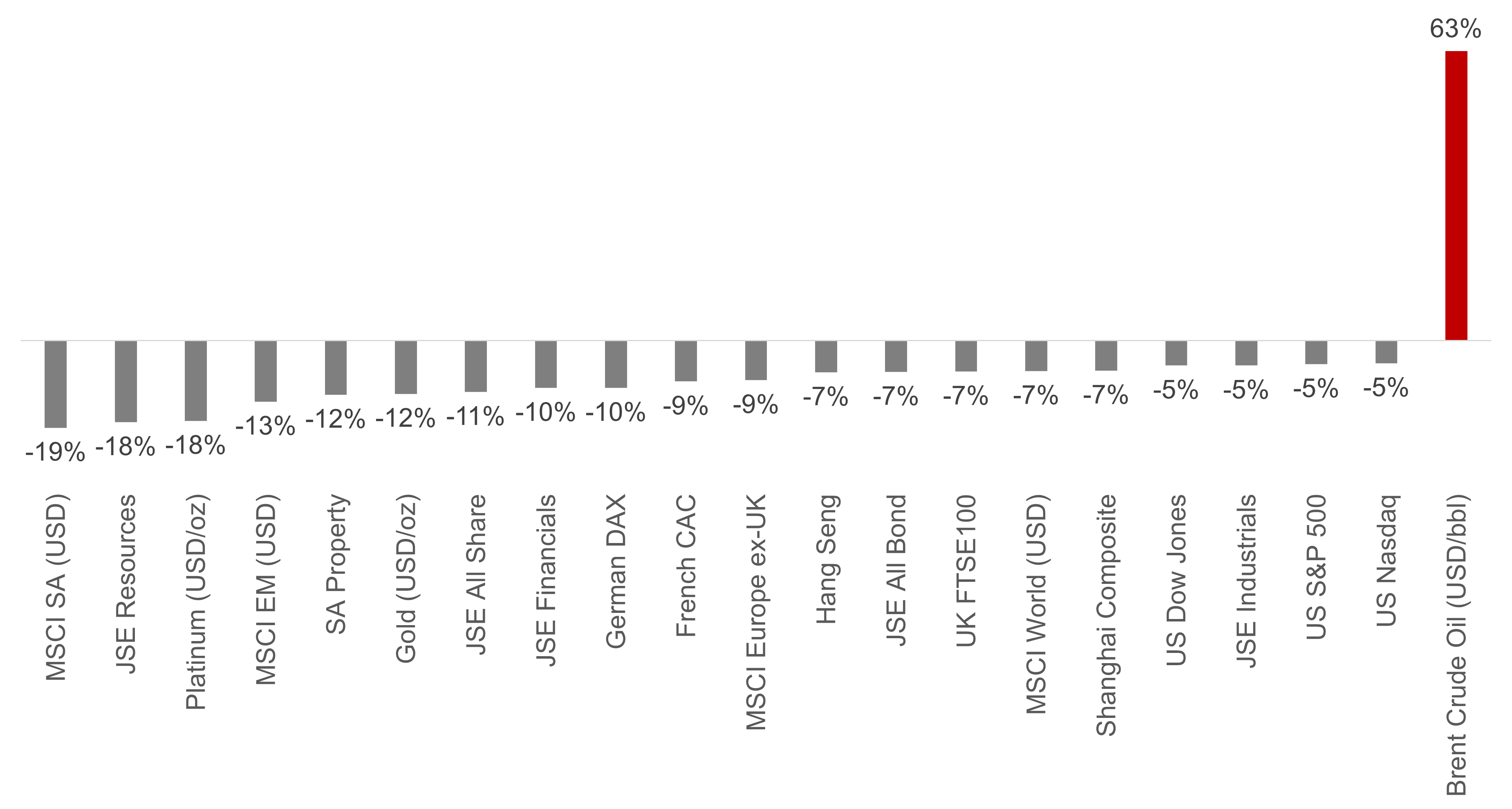
South African equities experienced a sharp reversal in March, ending a twelve-month winning streak as global shocks and commodity weakness weighed heavily on local assets. The FTSE/JSE All Share Index fell -11.2% MoM, marking its worst monthly performance since the Covid crisis in 2020, while the FTSE/JSE All Bond Index declined -6.8% MoM amid a sharp rise in yields. SA-listed property also came under significant pressure, falling -11.8% MoM, as all major asset classes ended the month in negative territory. The sell-off was broad-based, with the resources leading the decline (-17.8% MoM) as precious metal prices corrected sharply, followed by financials (-10.3% MoM) and industrials (-5.4% MoM). Precious metal miners, which had driven much of the market’s recent outperformance, were the largest detractors, with gold and platinum miners falling sharply in line with underlying commodity prices. In US dollar terms, MSCI South Africa declined -19.0% MoM, significantly underperforming both MSCI World (-6.6% MoM) and MSCI Emerging Markets (-13.3% MoM), as a weaker rand compounded losses.
South Africa’s macroeconomic backdrop became more uncertain in March as global developments introduced upside risks to inflation and interest rates. Although February inflation data remained benign, with headline and core CPI both easing to 3.0% YoY, the sharp increase in global oil prices shifted the outlook meaningfully. The South African Reserve Bank kept the repo rate unchanged at 6.75%, but struck a more cautious tone, highlighting the risk of second-round inflation effects and outlining scenarios that could necessitate future rate hikes. Bond markets reacted negatively, with the 10-year government yield rising sharply to around 9.3%, contributing to one of the worst monthly performances for local bonds on record. The rand weakened significantly, depreciating -5.9% MoM against the US dollar as global risk aversion intensified and investors rotated into safe-haven currencies.
Global markets were dominated by a sharp escalation in geopolitical tensions during March, triggering one of the most significant energy shocks in recent history. Military conflict involving the US, Israel and Iran, alongside the effective closure of the Strait of Hormuz, disrupted a critical global energy supply route and drove oil prices sharply higher. Brent crude surged, and ended the month up +63.3% MoM to over US$118/bbl, while global growth expectations weakened and inflation fears intensified. Global equity markets sold off broadly, with the MSCI World Index declining -6.6% MoM, its worst monthly performance in over three years. Rising energy prices and inflation expectations led markets to reassess the path of monetary policy, with expectations for rate cuts pushed out and bond yields rising globally. In contrast to the risk-off environment, precious metals declined sharply, with gold falling -11.6% MoM and platinum down -17.5% MoM, as higher real yields and a stronger US dollar reduced their relative appeal.
US equities declined meaningfully in March as geopolitical tensions, rising yields and weaker growth data weighed on investor sentiment. The S&P 500 fell -5.1% MoM, while the Nasdaq declined -4.9% MoM and the Dow Jones dropped -5.4% MoM, ending its ten-month winning streak. Markets were particularly sensitive to the inflationary implications of the energy shock, which drove US Treasury yields higher, with the 10-year yield rising above 4.4% before closing the month at 4.3%. The Federal Reserve kept rates on hold, emphasising uncertainty around the economic impact of geopolitical developments and the persistence of inflation risks. Economic data painted a mixed picture, with inflation broadly stable but growth slowing, as GDP was revised lower and labour market data surprised to the downside. Energy stocks were the clear outperformers, benefiting from the surge in oil prices, while broader equity markets struggled under tightening financial conditions and reduced expectations for policy easing. A flight to safety in the US greenback pushed the US Dollar Index up +2.4% MoM.
European equity markets were particularly hard hit by the energy shock, given the region’s reliance on imported energy. The MSCI Europe ex-UK index declined -8.6% MoM, marking its worst monthly performance since March 2019 when we had the COVID-19 induced market crash. Germany’s DAX and France’s CAC fell -10.3% and -8.9% MoM respectively. The UK market proved relatively more resilient, with the FTSE 100 declining -6.7% MoM, supported by its higher exposure to energy companies. Inflation in Europe edged higher, while economic growth remained subdued, reinforcing concerns around stagflation risks in the region as higher energy costs weigh on both consumers and industrial activity.
Emerging market equities also came under significant pressure, reversing much of their strong year-to-date performance. The MSCI Emerging Markets Index declined -13.3% MoM, underperforming developed markets as global risk aversion increased and capital flowed back into the US dollar. Commodity-producing markets faced mixed outcomes, with energy exporters benefiting from higher oil prices, while metal exporters were negatively impacted by falling prices. Chinese equity markets declined but were relatively more resilient than peers, supported by reduced dependence on Middle Eastern energy and signs of stabilisation in domestic economic activity. The Shanghai Composite fell -6.5% MoM, while the Hang Seng declined -6.9% MoM, as weakness in global risk sentiment outweighed improving macro data.
The hedge fund ended the month in negative territory, as detractors from the long book outweighed gains from the short book. Performance on the long side was primarily impacted by positions in Impala Platinum, Barrick Mining and Valterra Platinum, while Glencore was the main positive contributor. Within the short book, the largest gains were generated from index protection and positions in the gold mining and local property sectors, with minimal losses recorded across other positions.
South African equities extended their remarkable run in February, delivering another strong month of gains and marking a twelfth consecutive monthly advance. The FTSE/JSE All Share Index rose +7.0% MoM, outperforming bonds and most global peers as commodity-linked shares once again drove performance. The FTSE/JSE All Bond Index gained a more modest +1.7% MoM, while SA-listed property delivered a robust +6.3% MoM return. Sector leadership shifted during the month, with financial stocks emerging as a key contributor alongside resources. The FTSE/JSE Financial 15 Index advanced +7.4% MoM, supported by strong gains in banks and insurers, while the FTSE/JSE Africa Resource 10 Index surged +13.4% MoM amid renewed strength in precious metal prices. By contrast, industrial stocks remained broadly flat as weakness in large technology and investment holdings weighed on the sector. In US dollar terms, the MSCI South Africa Index rose +10.4% MoM, comfortably outperforming both MSCI World (+0.6% MoM) and MSCI Emerging Markets (+5.4% MoM).
South Africa’s macroeconomic backdrop remained broadly supportive in February. Headline inflation eased slightly to 3.5% YoY in January, down from 3.6% in December, while core inflation remained contained at 3.4%, close to the SARB’s 3% target. The 2026 National Budget was generally well received by markets and the taxpayers, reinforcing the country’s fiscal consolidation path while avoiding major tax increases. Strong commodity prices and improved revenue collection helped support the fiscal framework, allowing the National Treasury to project a narrowing budget deficit and debt stabilisation in the coming years. Bond market sentiment remained constructive, with the 10-year government yield hovering around 8%, near its lowest levels in almost a decade. The rand also strengthened modestly, appreciating +1.3% MoM against the US dollar, supported by commodity strength and improved investor sentiment toward South African assets.
Global equity markets delivered a mixed but resilient performance in February as investors navigated a complex backdrop of geopolitical tensions, AI-related market volatility and evolving policy developments. The MSCI World Index rose +0.6% MoM, extending its run of monthly gains despite weakness in US equities. Market leadership continued to broaden beyond US mega-cap technology names, with value-oriented sectors outperforming growth stocks. Commodities again played an important role in shaping global asset returns. Precious metals continued their strong rally, with gold rising +7.9% MoM while platinum and rhodium advanced +7.9% and +7.2% respectively over the month. Oil prices also firmed modestly (+2.5% MoM) as geopolitical tensions surrounding the US and Iran heightened concerns about potential disruptions to global energy supply.
US equities underperformed most major markets during February as investors continued to rotate away from large-cap technology stocks. The S&P 500 declined -0.9% MoM, while the Nasdaq fell -2.3% MoM as weakness in technology and software companies weighed on the broader index. By contrast, the Dow Jones managed a modest gain of +0.2% MoM, reflecting stronger performance in more traditional value-oriented sectors. A central theme during the month was growing scrutiny around the scale and sustainability of artificial intelligence investment. Major US technology firms outlined plans to significantly increase AI-related capital expenditure, with projected spending expected to exceed US$650bn in 2026. While demand for AI infrastructure remains strong, investor sentiment has shifted toward evaluating the long-term return on these investments. US economic data were mixed, with inflation moderating slightly but growth momentum slowing. The Federal Reserve’s preferred inflation gauge, core PCE, edged higher to 3.0% YoY, while US GDP growth slowed to an annualised 1.4% in the fourth quarter of 2025. Against this backdrop, US Treasury yields declined during the month, with the 10-year yield falling below 4.0%, while the US Dollar Index strengthened 0.6% MoM.
European equity markets continued to perform strongly, with the MSCI Europe ex-UK index up +3.5% MoM as it benefitted from improving economic data and investor flows seeking diversification away from the US technology sector. France’s CAC 40 advanced +5.6% MoM, while Germany’s DAX climbed +3.0% MoM. UK equities also delivered a robust performance, with the FTSE 100 rising +6.7% MoM and reaching record highs during the month. Inflation in the UK moderated to 3.0% YoY in January, down from 3.4% previously, reinforcing expectations that monetary policy may become more accommodative over time. However, economic growth remained modest, with the UK economy expanding only +0.1% in the fourth quarter of 2025.
Emerging market equities extended their strong start to the year, outperforming developed markets once again in February. The MSCI Emerging Markets Index rose +5.4% MoM, supported by strength in commodity-producing countries and continued rotation away from US technology stocks. Despite this broader strength, performance in China remained mixed. The Shanghai Composite Index gained +1.1% MoM, while Hong Kong’s Hang Seng Index declined -2.8% MoM as Chinese technology companies experienced their weakest monthly performance in over two years. Shares of several large Chinese internet platforms fell sharply amid intensifying competition and concerns around profitability, weighing on the broader technology sector. Nonetheless, the overall EM complex continued to benefit from improving global growth expectations and rising commodity prices.
The hedge fund ended the month in positive territory, as gains from the long book covered detractors from the short book. Performance on the long side was driven primarily by strong contributions from Barrick Mining, Impala Platinum, and MTN Group, while Tencent and Naspers were the largest detractors during the month. Within the short book, modest gains were generated from US index protection and positions in the technology sector. However, these were overshadowed by losses from short positions in gold mining stocks, followed by diversified mining stocks.